Which Guest Communication Platform Fits Your Property
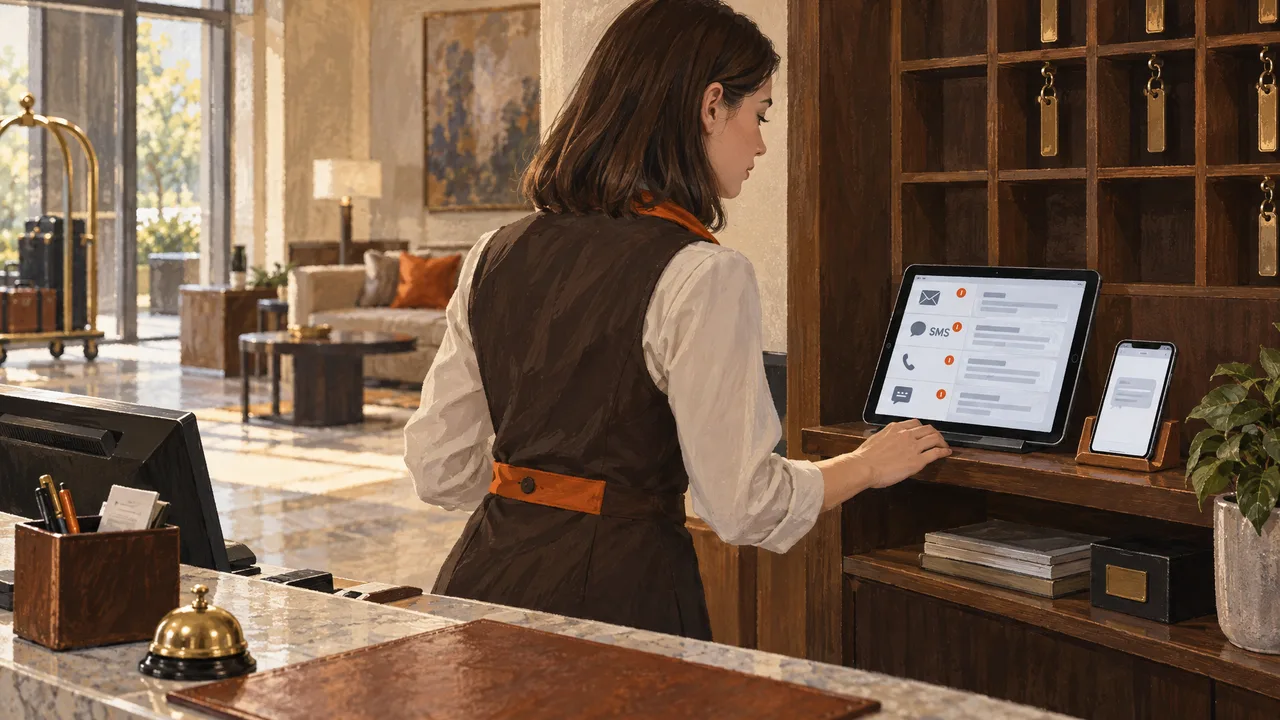
Akia fits properties whose front desk is drowning in routine questions, and Canary Technologies fits operations that want messaging bundled with check-in, payments, and upselling. The rest of this page is about the criterion most buyers never test. We sell in this category, so we have a stake in how you read it.
The criterion is thread continuity. A guest rarely sends one message. They send “we’re arriving late,” then “what’s the parking situation,” then “can we get a late checkout.” Three platforms answer all three. One of them shows your agent the first two while answering the third, and which one that is decides whether your hourly labor gets spent on hospitality or on archaeology.
Table of Contents
- Three Situations That Decide This Purchase
- The Real Options and Who Each One Fits
- Criteria That Separate a Guest Messenger From an Inbox
- How to Do It: A Two-Week Trial Before You Commit
- What to Ask Before You Commit
- About Sociocs
- Frequently Asked Questions
Three Situations That Decide This Purchase
The message volume that breaks a property is not the peak, it is the middle. Peak season makes you hire. The 4pm to 11pm window on a shoulder-season Tuesday, when one agent covers the desk alone, is where messages go unanswered and reviews get written. Count your inbound messages in that window for a week. That number, not your annual room nights, is the size of the problem you are buying against.
Your second situation is a ratio, and it is the one that quietly eliminates half the market. Write down how many inbound messages arrive per reservation. Properties sitting near one message per booking get solved by an inbox. Properties near three or more are running an operations problem, and an inbox alone will just make the queue visible without shrinking it. Neither shape is better. They need different purchases, and this single number is what tells them apart.
The third situation is date arithmetic. Replying inside a live conversation window is cheap and unrestricted, while starting a new conversation is where template approval and per-message billing enter the picture. If most of your outbound volume is transactional messages to numbers that cannot reply, you are buying a broadcast tool whether you meant to or not, and you should judge vendors on template handling and delivery reporting rather than conversation features.
The Real Options and Who Each One Fits
Only two named tools in this category carry enough published detail to compare on the dimensions that matter. Both focus on hospitality rather than general business texting, and both charge custom pricing you have to request, which means the comparison happens in a sales call unless you know what to ask.
| Option | Who it suits | Features as published | PMS integrations | Voice component | Cost |
|---|---|---|---|---|---|
| Akia | Properties wanting routine questions and calls handled without front desk intervention | Guest journey automation; SMS, Web Chat, Email | Opera, Mews, Cloudbeds, StayNTouch, plus STR PMSes | Yes (Dialer) | Custom |
| Canary Technologies | Operations prioritizing revenue and contactless check-in alongside messaging | Upselling and contactless operations; SMS, Email, Web Chat | Opera, Mews, Cloudbeds, StayNTouch | Yes (AI Voice) | Custom |
Akia’s published description positions it as an AI agent for hotels and vacation rentals that resolves guest messages and phone calls without front desk intervention. That is a strong fit for a property that has already tried staffing its way out of the queue and lost. The trade-off is the same one every automation-led tool carries: when a question falls outside the trained paths, resolution depends on how cleanly the handoff to a human is built.
Canary’s published description bundles AI-powered guest messaging with digital check-in and checkout, contactless payments, and upselling in one platform. This fits properties where the front desk is already evaluating check-in and payment tools, because combining those purchases avoids a second integration project. The trade-off runs the other direction: you are buying a broad operations suite, so messaging depth is one component among several rather than the whole product.
Whichever way you lean, the deciding question is whether the second message on a reservation lands in the same thread as the first. That is the difference between an inbox your agents work and a shared conversation history nobody scrolls back through.
Criteria That Separate a Guest Messenger From an Inbox
These are the checks that stay useful when a vendor you have never heard of shows up in a demo. Each one has a piece of visible evidence you can ask to see rather than a claim you have to trust.
- Thread continuity across channels. Ask them to reply to an email, then a WhatsApp message, then an SMS on the same reservation and show you the screen. If your agent sees three separate conversations, the platform is a router, not an inbox.
- Who can see the conversation. Ask how a shift change works. One login per property with a shared view is survivable. A tool that assigns a conversation to one named user and hides it from everyone else will strand guests every time that person is off.
- Template and window mechanics. Ask what happens when a message falls outside the reply window and whether the platform prompts the agent before the window closes. Platforms that ignore the clock push your team toward template-only communication, which reads like a broadcast to a guest who thought they were texting a person.
- Channel breadth that matches your guests. Ask for the last 90 days of inbound message counts by channel. If a vendor sells four channels and your guests use one, the extra three are a demo feature, not an operational one.
- Review and reputation loop. Ask whether a review request can be triggered from a closed conversation. Guest messaging and reputation management are the same job wearing two hats.
Google’s own description of RCS is a useful sanity check here: the company describes it as the messaging technology standard and says it offers an upgraded messaging experience beyond traditional SMS (Google Messages Help). The practical question for your purchase is whether a vendor treats rich messaging as a channel it will adopt or as a threat to the SMS billing it depends on.
How to Do It: A Two-Week Trial Before You Commit
Run the trial on your worst week, not a quiet one, and run it with the two finalists side by side rather than sequentially. Sequential trials let the second vendor benefit from everything the first one taught you, and you end up comparing your own learning curve instead of the products.
- Pick one property and one seven-day window, and route every inbound message through the platform under test while keeping your current method as a silent fallback. Nobody on the guest side should know a trial is happening.
- Seed a fake reservation and send the platform a three-message sequence with a day between messages, then check on the fourth day whether the agent answering sees all three. Do this on day one, before anyone gets attached to the tool.
- Hand the inbox to whoever actually works the late shift, not the manager who chose the software. Their objections in week one are worth more than a month of your own impressions.
- Export the conversation log on day fourteen and count how many threads closed without a reply. That count, not the demo, is your answer on whether the platform reduced or relocated your workload.
- Ask for the pricing sheet in writing on the same day you export the log. Guest messaging at hotels and motels usually runs on seasonal volume, and a seat-based price that looked reasonable in January has a way of looking different in July.
If the trial fails, the failure mode tells you what to buy instead. If threads closed but the volume never dropped, you need automation rather than a better inbox. If volume dropped but guests still complained, you have a routing problem and probably bought the wrong channel mix.
What to Ask Before You Commit
These are the questions that separate a vendor who has done hospitality implementations from one who has done demos. The weak answers are not disqualifying on their own. Taken together, they describe a platform you will be managing rather than using.
What happens to an open conversation when the assigned agent goes offline? A convincing answer names the reassignment rule and shows you where it is configured. A weak answer describes the feature as “coming soon” or tells you the supervisor can always reassign manually, which is an admission that nobody has solved the shift change.
Can a guest start a conversation on one channel and continue on another? Strong answers show you a merged thread. Weak answers explain that channels are kept separate for reporting purposes. That separation is convenient for the vendor and expensive for your front desk, and it is also the reason switching off SMS without losing the thread is harder than it should be when you change vendors later.
How do you bill a message that gets no reply? Vendors who bill per message sent should show you a breakdown of outbound volume by type. If they cannot separate marketing sends from service replies, your seasonal invoice will be a surprise every year.
What does the first week of implementation actually involve, and who does it? A convincing answer names a real onboarding sequence with your PMS and tells you which team owns each step. A weak answer says the platform is “self-serve” and leaves your front desk to figure out the mapping alone.
How do you handle a guest who asks to stop receiving messages? Strong answers built into WhatsApp business messaging start from a real constraint: you may only initiate conversations using an approved Message Template, though you may reply to a user message without a template as long as it is within the 24-hour customer service window, which opens and resets with each user message (WhatsApp Business Messaging Policy). A vendor who can explain that distinction in plain English understands the channel they are selling.
What is your exit procedure? Ask for the conversation export format before you sign. A vendor who has never been asked this question has never lost a customer gracefully, and that is information you can use.
About Sociocs
We built Sociocs for the middle situation, the property with three or more messages per reservation and a front desk that cannot keep a conversation straight across channels.
Google Reviews and Google Q&A management runs next to the messaging, so a conversation that ends in a review request does not require a second tool. An online form builder with spam blocking and a no-code API covers the pre-arrival side, and Android App Reviews from Google Play keeps app feedback in the same place as the thread that generated it.
Choose differently if your operation needs a physical phone system to ring a desk phone when a guest calls, or if you need an AI voice agent answering calls end to end. Akia and Canary both publish a voice component; we do not sell one. Choose differently if contract-level upselling and contactless payment are the core of your operations and messaging is a feature you want thrown in.
If your problem is that conversations are scattered and your team cannot see them, that is what we build. Start on the free tier, bring one hotel into it, and see whether the thread holds. When you are ready to talk through your setup, get in touch, and current plan details are on our pricing page.
Frequently Asked Questions
What is an example of a communication platform?
Sociocs is one: a shared inbox for business text messaging, WhatsApp Business messaging, Facebook Messenger, Instagram, and Telegram, with Google Reviews and Google Q&A management in the same workspace. The category is broader than that, though. Akia and Canary Technologies are examples built specifically for hotels and vacation rentals, and general business texting services occupy the same shelf. What makes something a communication platform rather than a single app is that it holds more than one channel and more than one person’s view of the conversation.
What is the best free communication app?
The honest answer is that free tiers buy you capacity, not capability. Sociocs runs a forever-free tier with two channels, one user, and a thousand messages a month, which is enough to test whether a shared inbox changes how your team works. WhatsApp and Google Messages are free because messaging is their product, and neither routes your guest conversations into a shared team view. Pick free tools to learn the workflow, then pay for the piece that keeps a thread whole across shifts.
Does a guest communication platform replace the front desk?
No. Every named option in this category assumes a human is still working the queue, including the ones with an AI agent. Automation resolves the routine questions and escalates the rest, and the escalation path is where most implementations quietly fail. What the software replaces is the scavenger hunt, the agent searching three apps to find what a guest asked yesterday.
Will guests actually use a text channel?
Guests use whatever number or link you give them at booking and check-in, so the channel choice matters less than the handoff. The measurable question is whether the same thread survives a shift change and a channel change. If it does, usage follows. If it does not, guests notice within two messages and go back to calling the desk.