What This Emoji Mean in Texting Depends on Who Sent It
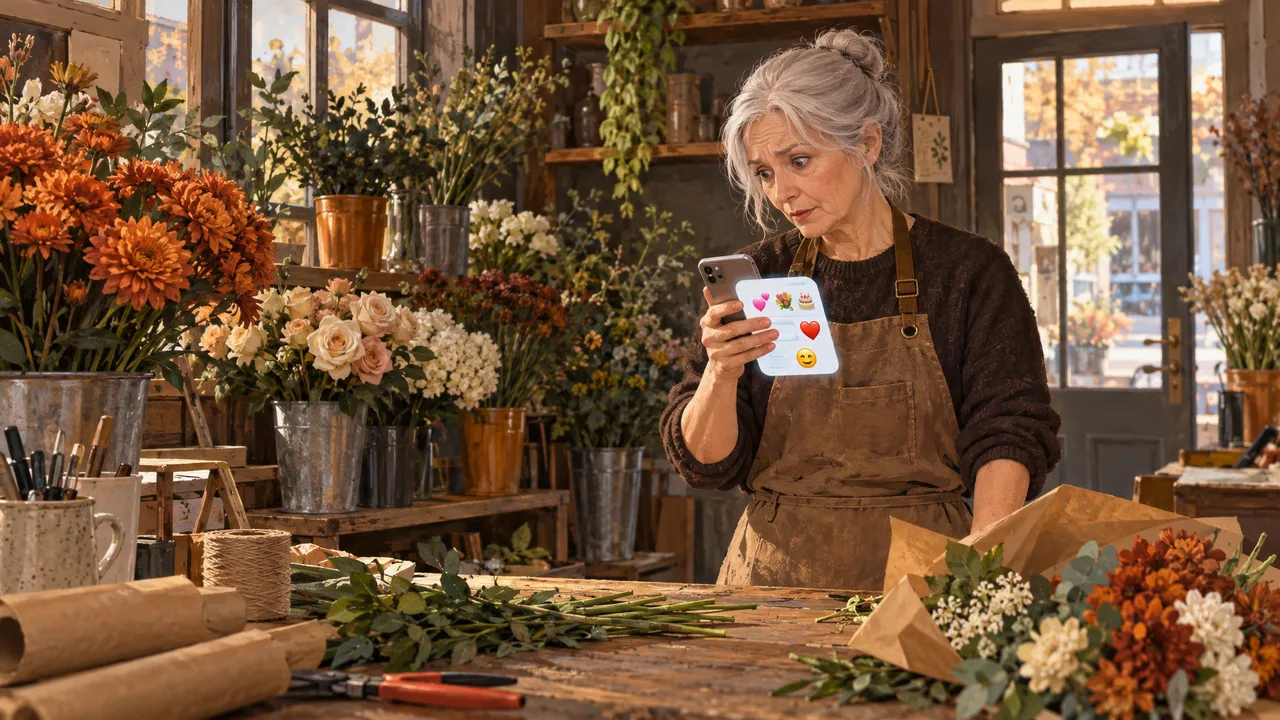
An emoji’s meaning in a text is decided by the sender, the audience, and the channel, not by its official Unicode name, so read the sentence around it first and the face second. That is the whole reading method, and it beats memorizing a chart of faces. In business messaging the stakes are sharper: a face that lands wrong in a customer thread reads as sarcasm or dismissal, and the customer does not ask you to clarify.
The Character Has a Name; the Meaning Belongs to the Thread
A character’s Unicode name describes the face it depicts; the meaning it carries in a thread is negotiated between the two people typing. Zany Face was approved as part of Unicode 10.0 in 2017 under the name “Grinning Face with One Large and One Small Eye” and added to Emoji 5.0 in 2017, per Emojipedia. That name tells you a tongue is out and one eye is wide. It does not tell you whether the sender is joking, mocking you, or telling you they got away with something.
That gap between official name and lived meaning is not a small edge case. Half of U.S. emoji users (50%) say they use emoji differently than their intended meaning, according to Adobe’s 2022 U.S. Emoji Trend Report, as reported in a summary of the survey. Half the people you message are already using the face as a private shorthand.
Treat the emoji the way you treat a tone of voice: it modifies the words in front of it and means little on its own. A thumbs-up after “confirmed, we’ll see you Tuesday” is a receipt. The same thumbs-up after “we’ll need to reschedule” is not.
Why the Same Face Reads Differently on Each Side of the Screen
Emoji reading is not a single skill that everyone has equally. It varies by age, and it varies by how much a person has invested in the face as a private code. Adobe’s 2022 U.S. Emoji Trend Report found that 74% of Gen Z emoji users use a given emoji to mean something different from its intended meaning, versus 65% of Millennials, 48% of Gen X and 24% of Boomers, per the same survey summary.
That spread explains most cross-generational confusion in a customer thread. The sender is fluent in the colloquial layer. The reader is working from the dictionary layer. Neither is being careless.
Where do the meanings come from in the first place? Some of them are learned from usage in public posts, which is why researchers have tried to model emoji meaning from the public text around them, as in the 2016 paper “What does this Emoji Mean? A Vector Space Skip-Gram Model for Twitter Emojis” from the Language Resources and Evaluation Conference. The meanings are inferred from context, not decreed.
And the cost of a bad reading is real. Goofy as it sounds, “1 in 3 Gen Z’ers (32%) has ended a relationship with someone using an emoji,” per Adobe’s 2022 U.S. Emoji Trend Report. A customer is not a romantic partner, but a customer who reads a winking face as mockery can walk for the same reason.
How to Read an Emoji Before You Reply
Reading a face is a small process. Do it in order, and you will catch most misreads before they cost you a reply.
- Cover the emoji and read the plain sentence. Write down what the sentence alone says. That is your baseline, and any emoji has to be reconciled against it.
- Identify whether the emoji modifies or replaces the words. A 😊 after “all done” softens a status update. A 😊 on its own after a complaint is a replacement, and it means something the sender expects you to infer.
- Ask who is typing. A Gen Z customer and a Boomer customer sending the same face are drawing on different codebooks. The generation gap in intended meaning is documented, and it is wide.
- Read the channel. A laughing face in an SMS recovery message reads differently from the same face in an Instagram comment where the audience is public.
- Reply in plain words first, then add your own face sparingly. Your plain sentence disambiguates theirs.
This is how context beats rules in business texting, and the same principle covers symbols just as well. Nobody funds a decoder, so build the habit instead.
The one place a fixed meaning is safe is when the emoji stands alone as a complete reply. A lone 👍 from a customer almost always means “acknowledged, no action needed.” A lone 😊 is not a thank-you; it is a silence that expects you to carry the conversation.
Where Emoji Go Wrong in Customer Messages
Sarcasm is the first place it breaks. A customer writes “great, another delay 😒,” and an agent who has been trained to match positivity replies with a cheerful face. The emoji was a complaint, and matching it reads as not listening. Read the hostility and respond to the substance.
Forty-seven percent of U.S. emoji users have sent an emoji that was misinterpreted or taken out of context, per Adobe’s 2022 U.S. Emoji Trend Report, per the survey summary. That is the number to keep in your head the next time you want to write “no worries 😅” on a refund thread. Half the room will read the sweat as relief, and half will read it as awkwardness.
Businesses also apply the old shorthand rules to a new reality. The 100 texting abbreviations guide that served a personal phone does not transfer to a shared business inbox, where the person on the other end may not know what “idk” or “nvm” means and where every message can be screenshotted. The hidden cost when texting compounds when the symbol is ambiguous too. A safety net that fails silently is not a safety net.
Then there is accessibility. A face that conveys real information, like “this is a joke” or “this is urgent,” is invisible to a screen reader that announces the character’s official name or skips it. If the meaning matters, the words have to carry it.
A quieter mistake: using emoji to repair a relationship you have not repaired in words. Empathy is not something you paste. Adobe’s 2021 Global Emoji Trend Report found that 88% of global emoji users are more likely to feel empathetic toward someone if they use an emoji, per Adobe’s report. That 88% is about feeling toward the sender, and it cannot manufacture a resolution a customer has not been given.
Plain Words or a Wink: Deciding Per Message
You face a real choice in every customer thread: send it plain, or send it warm. The signals that settle it are rarely about the emoji itself.
Send warm, with a face or two, when the message is transactional and the relationship is already fine. An appointment confirmation, a delivery heads-up, a quick thank-you after a resolved ticket. A smile here reads as a person, not a robot. Adobe’s 2021 Global Emoji Trend Report found global emoji users include emoji in their messaging nearly half of the time (46%) and use emoji exclusively a quarter of the time (25%), per Adobe. Customers expect some warmth because they send it themselves. ➂
Go plain when the message carries a cost. A refund confirm, a complaint response, a billing question, a policy denial. No face goes near a denial. If the reader feels wronged, the face reads as mockery, and the plain sentence is the only version that cannot be misread.
Take your cue from the customer’s own message. If they wrote plain and short, answer in kind. If they wrote “thanks so much!! 😊😊,” mirror one face, not five. The mirror stops short of matching intensity because you are the company, and you sound like a person, not a friend, when the ratio slips.
And think twice about abbreviations in the same breath as the face, because both are shortcuts that read as informal. On a service thread they read as careless.
How We Keep Emoji-Laden Threads Readable for a Team
We built Sociocs as a business texting and omnichannel customer engagement platform because the customer reading is not the only reading that matters. The team has to read it too. In a shared inbox, a customer’s ambiguous face becomes a thread the whole team can see and discuss before someone answers, rather than a private judgment on a personal phone that no one can audit.
The channels that carry the most emoji-rich messages, Instagram DMs, WhatsApp chats, and Facebook comments, all land in the same place. Instagram DMs, story mentions, and story replies are covered too, and WhatsApp Business messaging with click-to-chat lives in the same inbox. Business text messaging runs through Twilio or Telnyx with MMS support, so a picture or a face in a text stays visible to everyone who needs to reply.
We are the right choice if your team fields customer messages across text, WhatsApp, Instagram, and reviews and you want one view of the conversation history before anyone types back. We are not the right choice if you are a solo operator who answers from one phone and never hands a thread to a second person; a shared inbox is overhead you do not need yet, and there is nothing in our tool that changes that math. If that is you, think twice before you shorten your replies anyway, because the customer on the other end reads them alone.
If a team inbox is the fit, get in touch and we will walk through the setup. You can compare plans on our pricing plans page and pick the tier that matches your channel count.
Frequently Asked Questions
What does the 🤪 emoji mean?
Zany Face depicts a grinning face with a tongue out and one eye wide, approved under that descriptive name in Unicode 10.0. In a text it usually reads as playful, silly, or “I got away with something,” a joke marker more than a literal mood. It is one of the faces where the sender’s intent and the reader’s guess most often diverge, so treat it as tone rather than content and read the sentence it follows.
What do emoji 2 exclamation marks mean in texting?
Two exclamation marks after a word signal emphasis or excitement, and how much depends on the person typing. A business can read “Thanks!!” as genuine energy or a slightly rushed reply, and the emoji do not change the words. As a sender, one mark is enough on a customer message, because doubling a mark on a complaint or a policy answer reads as tone-deaf. Match the customer’s warmth without exceeding it.
What does 🤗🤗🤗 mean from a girl?
Three hugging faces together usually read as warmth or affection, a way of softening a message and showing the sender is happy to hear from you. It can also read as friendly but not flirtatious, and it can read as a habitual sign-off from someone who uses it with everyone. Read the words around it. If the sentence is businesslike, the three faces are courtesy; if it is personal, they mean more.
What does this symbol mean in chatting?
Most chat symbols carry a widely understood core meaning and a smaller, sender-specific meaning layered on top. The core is what a dictionary-style chart gives you. The layer on top comes from the sender’s age, the channel, and the sentence. When the two conflict, trust the sentence and the relationship before you trust the face, and if the reply matters, ask in plain words rather than guessing.