Twilio SMS Pricing Beyond the Sticker Rate: What You Pay
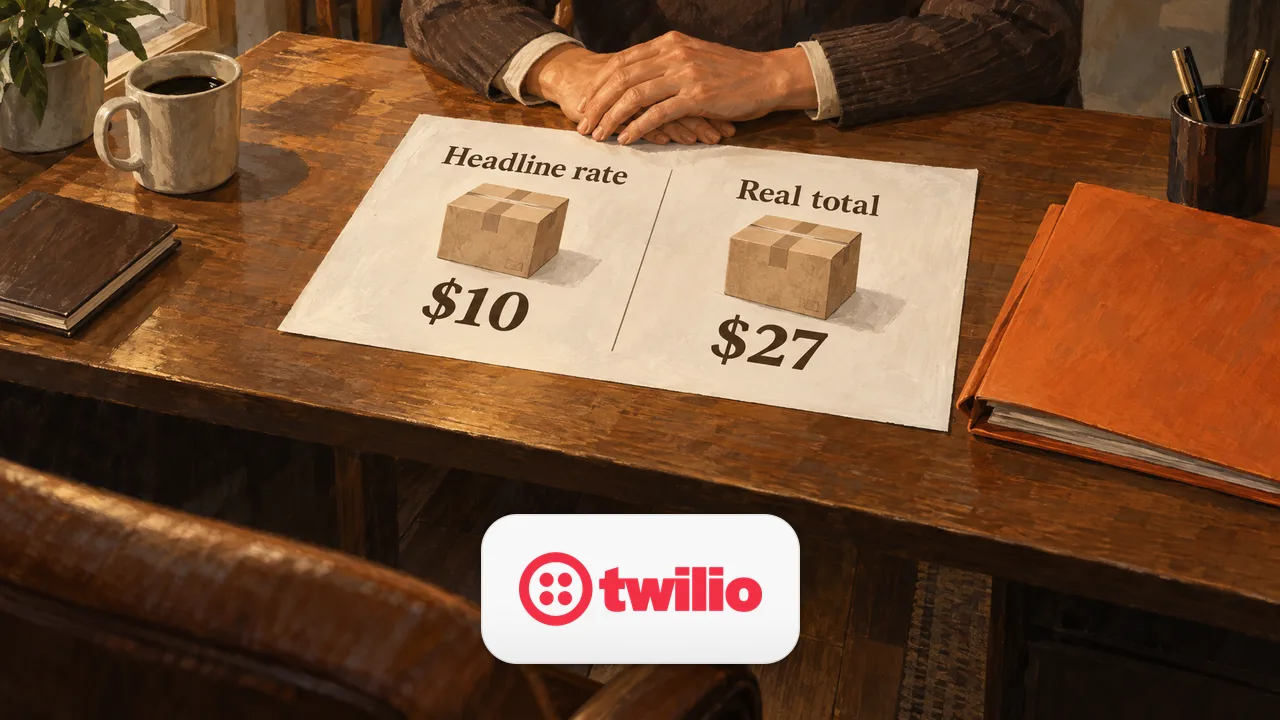
Twilio SMS pricing starts at $0.0083 per outbound or inbound message segment, plus carrier fees, according to Twilio’s messaging pricing page. That number buys you delivery. It does not buy you an answer, a thread, or a human who knows what the customer asked last week. Read the rate card as a transportation cost and the rest of your messaging budget stops looking like a mystery.
Table of Contents
- The Rate Card Is a Delivery Price
- Where Teams Misread the Bill
- Signals That You Have Outgrown Pay-Per-API
- A Budget Model You Can Actually Run
- The Case Where the Rate Card Is Not Enough
- About Sociocs
- Frequently Asked Questions
The Rate Card Is a Delivery Price, Not a Communication Price
Twilio sells a rail. Messages move along it, and you pay per segment that moves. Twilio says its messaging pricing starts at $0.0083 per outbound or inbound message segment, plus carrier fees, on its messaging pricing page. That is the whole transaction as far as the rate card is concerned.
What happens at either end of the rail is someone else’s line item. A customer texts “is my order coming today,” the message lands in a queue, and now a person has to find the order, answer the question, and remember to follow up when the carrier slips a day. None of that shows up in a per-segment rate.
This is the part of the topic that what a Twilio SMS provider actually does makes concrete. The API handles transport, compliance plumbing, and carrier handoff. The conversation handling, the shared view of who replied to whom, and the follow-up discipline sit above it. Budget for both or your per-message math is fiction.
Pricing also is not one number. Twilio notes that the total cost of messaging varies by monthly volume, API, sender, and channel fees on its pricing overview. Four variables, and most teams model one.
Where Teams Misread the Bill
The first mistake is treating the headline rate as the bill. A team sees $0.0083, multiplies by monthly volume, and presents a number to finance. Carrier fees, sender-type surcharges, and message segmentation never enter the math. A single long text becomes multiple segments, and each segment bills.
Second, failures get filed as free. Twilio applies a failed message processing fee of $0.001 per message, and only to messages that terminate in a Failed status. That sounds trivial until a retry loop fires on a bad number list. Failed attempts bill, they repeat, and nobody watching the send volume catches it because the message never arrived.
Third is the cost nobody puts in the forecast: the human on the other side. If your team runs an API and a spreadsheet, answering “what did this customer ask last time” costs salary, not credits. Teams compare per-message rates across vendors and skip the labor comparison entirely, which is like choosing a car by fuel price and ignoring the payments.
Fourth, trial behavior gets baked into planning. Twilio includes 100 free SMS messages in its trial account, and trial accounts expire after 30 days, per Twilio’s trial documentation. Two weeks of testing feels free. Production does not, and the jump is abrupt.
Skipping the recipient list is the fifth. This is a delivery layer, not a marketing system, and the difference is covered in the audience layer SMS delivery skips. Per-message cost is a function of volume, and volume you cannot segment is volume you waste.
Multimedia changes the shape of the number too. Outbound MMS in the US costs $0.022 per message across long codes, toll-free, and short codes on Twilio’s US SMS pricing page. A product photo per message costs roughly three times a plain text. Most teams discover this after the first campaign, not before.
Signals That You Have Outgrown Pay-Per-API
Watch for these before they show up as a budget surprise:
- Send volume grows but reply volume grows faster, and nobody owns the replies.
- Two people on your team answer the same customer because the messages live in different tabs.
- Your monthly Twilio invoice is predictable while your support headcount is not.
- Failed sends appear on the bill with no list hygiene process behind them.
- Someone asks for a WhatsApp or Instagram option and the request dies because it is a separate build.
- Finance asks for cost per answered conversation and nobody can produce it.
Weight these by whether they touch revenue. An unowned reply is lost revenue. A failed send on a stale list is wasted spend, but small. A second channel request is a growth signal, and it is the one teams most often postpone until a competitor moves first.
A Budget Model You Can Actually Run
- Total your outbound and inbound segments for a typical month, not your best month.
- Multiply by $0.0083 and add carrier fees your account manager or dashboard confirms.
- Add failed-send volume at $0.001 per failed message, then estimate the retry rate behind it.
- Split MMS volume out and price it at $0.022 per message if you send images.
- Estimate hours your team spends finding context and answering replies, then price those hours at loaded salary.
- Add any second channel you plan to run, priced the same way.
- Compare that total against a platform whose plan price already bundles the inbox, the channels, and the message allowance.
That last line is where the comparison actually gets fair. A platform plan gives you one invoice for sending plus conversation handling. The API gives you a smaller invoice and a larger internal cost. Run both columns before you pick.
The Case Where the Rate Card Is Not Enough
When your messaging is outbound-only, high-volume, and fully automated, the rate card is your budget. Alerts, one-time codes, delivery notifications: no human reads the reply because there is no reply. Pay per segment and stay on the API.
When replies matter, the decision flips. You are not buying transport anymore. You are buying a place where conversations live, get assigned, and get closed. Per-message rates are the wrong unit for that job, and optimizing them can make the real cost worse by encouraging volume over resolution.
The honest test is one question. Does a human ever need to read what comes back? If yes, price the inbox. If no, price the rail.
About Sociocs
Sociocs is built for the side of the line where replies matter. Business text messaging runs through Twilio or Telnyx with MMS support, and WhatsApp, Facebook Messenger, Instagram, Telegram, and Google Reviews all land in the same shared inbox your team already watches. Online forms with spam blocking and a no-code API feed new conversations into that same place instead of a separate tool.
Pricing follows the same logic. The free plan is 0 USD monthly with 2 channels, 1 user, and 1,000 messages. Standard is 24 USD monthly with 2 channels, 2 users, and 2,000 messages, with $1 per 1,000 additional, or 20 USD monthly on annual billing (as of June 2026). Premium covers unlimited channels and 10 users at 149 USD monthly, or 124.17 USD monthly annually.
Choose something else if you send pure transactional traffic and never read a reply. A raw carrier API is cheaper for that, and no inbox will earn its keep. If your customers text back, start at our contact page and put the pricing page next to your current invoice.
Frequently Asked Questions
How many SMS are free in Twilio?
Twilio includes 100 free SMS messages in its trial account, and the trial expires after 30 days, per Twilio’s trial documentation. Those 100 messages exist for integration testing, not for a pilot campaign. Once the trial ends, every outbound and inbound segment bills at the messaging rate, plus carrier fees. Treat the trial as a sandbox for wiring your code and confirming delivery, not as a free tier you can stretch.
What’s cheaper than Twilio?
It depends what you are counting. If you only send automated alerts and never read replies, almost nothing beats raw per-message pricing on a carrier API, because you are buying pure transport. If your customers text back and a person has to answer, the cheaper option is usually a platform plan that bundles the inbox, the channels, and a message allowance into one predictable invoice. Sociocs starts on a free plan at 0 USD monthly with 1,000 messages, then moves to Standard at 24 USD monthly (as of June 2026), which replaces per-conversation labor you are currently paying for through salary instead of a line item.
Does Twilio SMS pricing include the cost of replies?
No. Inbound and outbound segments both bill, so a reply is a second transaction on the same rail. What is not included is the person who reads that reply, finds the order, and answers the customer. That cost lives in your payroll, not your Twilio invoice, which is why comparing per-message rates across vendors tells you almost nothing about total communication spend.